

 See My Latest Article on HelloNation
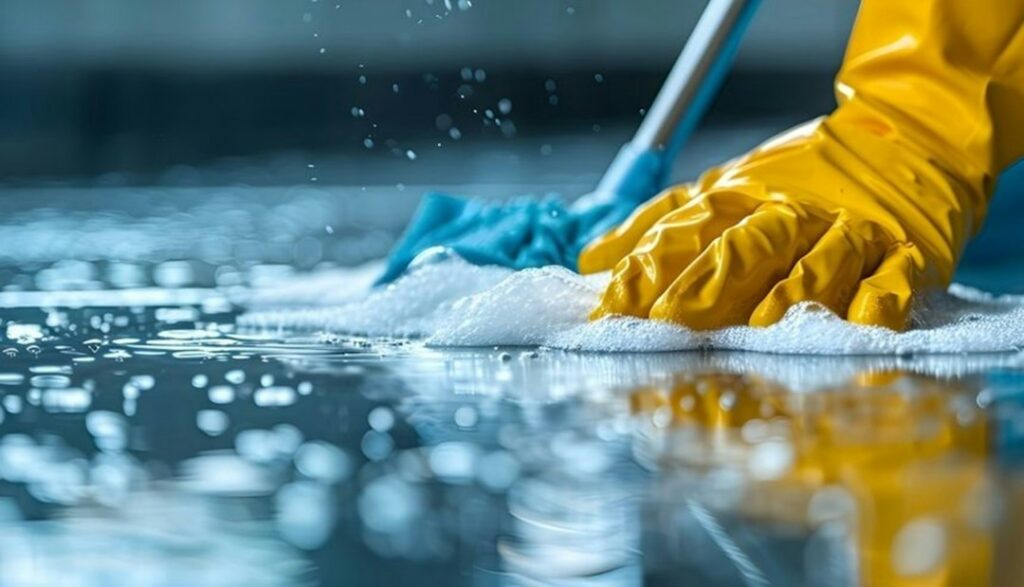
Cleaning products affect more than appearance. The right product can reduce germs, protect flooring and surfaces, limit indoor odors, and make routine work safer for employees, residents, and visitors. The wrong product may damage finishes, leave slippery residue, worsen indoor air quality, or fail to clean effectively.
For facilities in Tucson, AZ, product selection also needs to account for dust, dry conditions, intense sunlight, hard-water deposits, and the frequent movement between outdoor and indoor spaces.
What should be considered before selecting a cleaning product?
Start with the surface, the type of soil, the level of risk, and the cleaning method. A product should solve the actual cleaning problem without creating a new one.
Before purchasing or using a cleaner, identify:
- Surface material: Examples include sealed concrete, ceramic tile, vinyl, natural stone, painted walls, glass, stainless steel, carpet, and laminate.
- Soil type: Dust, oily residue, food spills, soap scum, mineral scale, biological contamination, and adhesive residue may require different chemistry.
- Use of the space: A restroom, medical area, childcare space, office, warehouse, and residential common area do not have identical cleaning needs.
- Frequency of cleaning: Daily maintenance may call for a mild cleaner, while periodic deep cleaning may require a stronger product.
- User exposure: Products used in occupied areas should be evaluated for odor, ventilation requirements, residue, and potential skin or respiratory irritation.
A cleaner that works well on tile may dull stone, damage a floor finish, or discolor grout. Reading the product label and the surface manufacturer’s care instructions is more reliable than assuming that a “multi-purpose” label means universal compatibility.
How do pH levels affect cleaning performance?
pH helps indicate whether a product is acidic, neutral, or alkaline. In general, acidic cleaners help dissolve mineral deposits, while alkaline cleaners are more effective against grease and many organic soils.
Typical uses include:
- Neutral cleaners: Routine cleaning of finished floors, walls, and other surfaces that do not need aggressive chemistry.
- Mildly alkaline cleaners: Removal of body oils, food residue, and general grime.
- Acidic cleaners: Mineral scale, hard-water deposits, and some restroom buildup.
- Strongly alkaline or acidic products: Specialized work that requires strict handling and surface compatibility checks.
Stronger does not always mean better. A concentrated chemical can etch metal, weaken floor finishes, damage grout, or leave a residue that attracts more dust. For regular maintenance, the least aggressive product that performs adequately is usually the most practical choice.
Which products work best for dust in Tucson facilities?
Dry climate conditions can make dust a recurring maintenance issue. Dust may enter through doors, settle on horizontal surfaces, collect around air returns, and become airborne again when people walk across untreated floors.
Routine dust control is usually more effective when it combines:
- Entry mats that are cleaned or replaced before they become saturated with soil.
- Vacuuming with equipment designed to capture fine particles.
- Damp dusting rather than dry feather dusting in occupied areas.
- Cleaning from higher surfaces downward so loosened dust is not redeposited.
- Frequent attention to corners, baseboards, vents, ledges, and spaces beneath furniture.
A heavily scented product does not remove dust more effectively. Fragrance can also become an indoor-air concern for people who are sensitive to perfumes or volatile ingredients. Unscented or lightly formulated products may be more suitable in offices, shared housing, classrooms, and other occupied settings.
How should hard-water deposits and mineral buildup be handled?
Mineral deposits often appear as white or cloudy residue on faucets, shower walls, glass, and restroom fixtures. These deposits are different from ordinary dirt and may not respond to a neutral cleaner.
An appropriately selected acidic cleaner can help dissolve mineral scale, but it must be used carefully. Acidic products may damage natural stone, cement-based grout, some metals, and certain coatings. Test the product in an inconspicuous area and follow the required dwell time rather than leaving the chemical on the surface longer than directed.
Never mix an acidic cleaner with chlorine bleach or any product containing ammonia. Dangerous gases or vapors can result. Chemical containers should remain labeled, closed, and stored away from incompatible products.
Are disinfectants necessary for everyday cleaning?
Disinfectants are not needed for every surface or every cleaning task. Cleaning removes soil; disinfecting uses a product intended to reduce specified microorganisms under stated conditions.
For routine work, cleaning with a suitable detergent may be enough. Disinfection becomes more relevant when:
- A surface has been contaminated with bodily fluids.
- A facility has a documented infection-control requirement.
- High-touch surfaces need additional treatment based on the space’s risk level.
- A product label identifies the intended organism and surface use.
A disinfectant cannot work properly through heavy dirt, grease, or dust. Pre-cleaning is often necessary, and the surface must remain visibly wet for the label’s required contact time. Wiping it dry immediately may reduce the product’s effectiveness.
Avoid using disinfectants as general-purpose air fresheners or applying them more frequently than necessary. Overuse can increase chemical exposure without improving the underlying cleaning program.
What does “green” or “natural” mean on a cleaning label?
Terms such as “natural,” “eco-friendly,” and “green” do not automatically explain how a product performs or how safe it is. A better evaluation looks at the label, safety data sheet, ingredients when available, dilution instructions, packaging, and disposal guidance.
A lower-impact product should still be judged on:
- Whether it cleans effectively at the recommended dilution.
- Whether it leaves residue that attracts dust or creates slip hazards.
- Whether it is compatible with the surface.
- Whether workers need gloves, eye protection, or ventilation.
- Whether the packaging and concentrated formula reduce unnecessary waste.

Products with plant-derived ingredients can still irritate skin or eyes. Products with familiar household ingredients can still be hazardous when concentrated or mixed incorrectly. Safety depends on the complete formulation and how it is used, not on a single marketing description.
How can facilities reduce chemical waste and mistakes?
Accurate dilution is one of the simplest ways to improve safety and control costs. Too much chemical may leave residue, damage surfaces, increase exposure, and create unnecessary waste. Too little may fail to clean and encourage repeated applications.
Good practices include:
- Use clearly labeled measuring equipment or a controlled dispensing system.
- Keep ready-to-use and concentrated products separated.
- Do not transfer chemicals into unmarked bottles.
- Maintain current safety data sheets where employees can access them.
- Train workers on contact time, personal protective equipment, storage, and spill response.
- Record which products are approved for each major surface.
- Remove outdated, leaking, or unidentified containers from service.
A written product list can prevent staff from choosing a stronger chemical simply because it is available. It also makes it easier to identify substitutes when a product is unavailable or no longer appropriate.
What products are safest for floors and high-traffic areas?
Floor care depends on the flooring material and finish. A neutral cleaner is often suitable for routine maintenance of finished resilient flooring, but unsealed concrete, stone, ceramic tile, and textured safety flooring may need different approaches.
In high-traffic areas, check whether the cleaner:
- Leaves a slippery film.
- Attracts dust after drying.
- Attacks the floor finish.
- Requires rinsing.
- Produces strong fumes during occupied hours.
- Works with the facility’s mop, auto-scrubber, or vacuum system.
More product is not a substitute for proper soil removal. Clean equipment, correct water changes, adequate dwell time, and appropriate agitation often matter as much as chemical strength.
When is specialized guidance necessary?
Routine product selection can usually be managed through labels, safety data sheets, surface-care instructions, and staff training. Specialized guidance is appropriate when a facility has unknown chemical residues, extensive mold growth, sewage contamination, a major bodily-fluid spill, damaged hazardous materials, or a surface that may contain regulated materials.
For ordinary maintenance, the soundest approach is simple: identify the soil, confirm the surface, select the mildest effective product, follow the label, and prevent incompatible chemicals from being mixed or stored together.